In 1854 a singing teacher became the first person to watch the human vocal folds at work in singing. Manuel García the son's simple experiment with two mirrors opened the scientific study of the voice and gave medicine one of its basic instruments.
The experiment
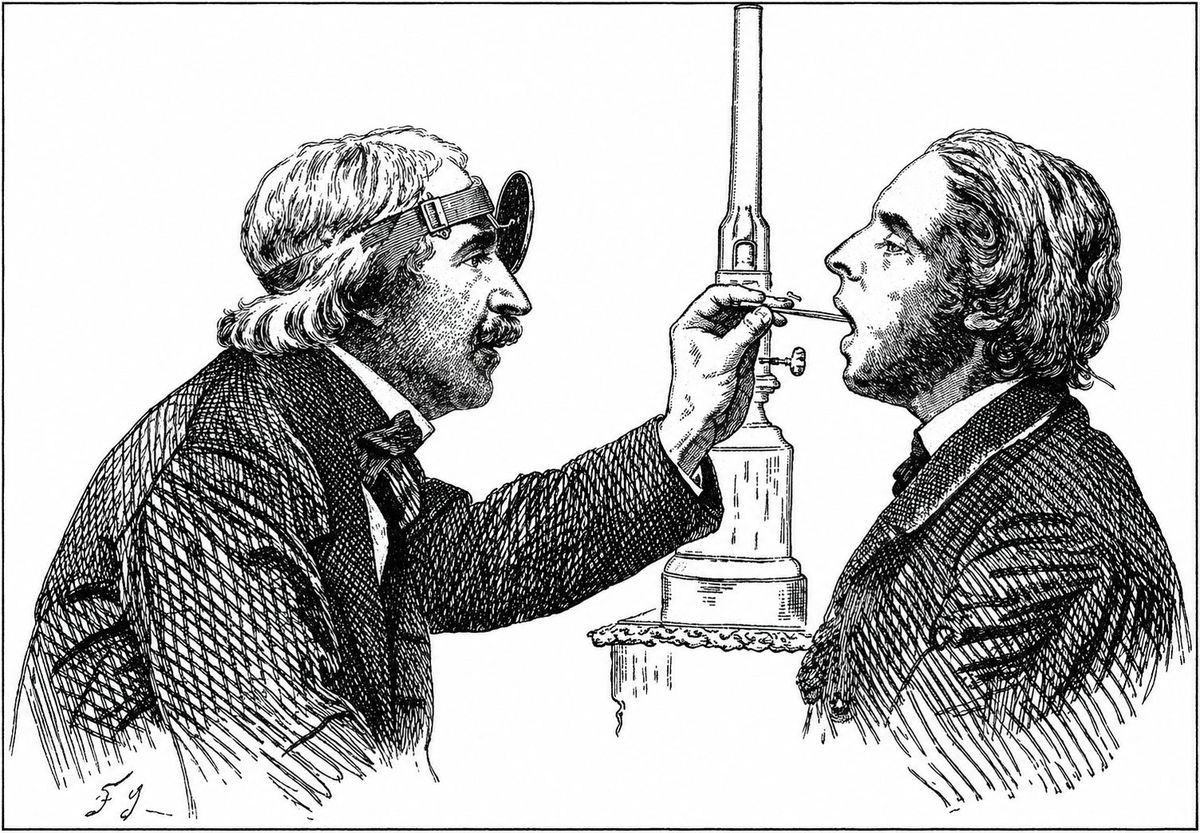
García had studied the anatomy of the larynx since his years in French military hospitals in the 1830s, but no one could see the living larynx while it produced sound. In September 1854, during a stay in Paris, he had the idea of using mirrors. He placed a small dentist's mirror at the back of his throat and used a hand mirror to reflect sunlight onto it. In the small mirror he could see his own glottis, and watch how it changed as he sang.
The paper of 1855
García described what he had seen in a paper titled "Observations on the Human Voice". It was received by the Royal Society in London on 22 March 1855, communicated by its secretary, Dr William Sharpey, and published in the Proceedings of the Royal Society, volume 7, pages 399–410. The paper discusses the opening and movement of the glottis, the production of the chest voice and the falsetto, the registers of the voice and the pressure of air. It was reprinted in the journal The Laryngoscope in 1905.
Before and after García
García was not the first to try to see the larynx with a mirror. Earlier attempts had been made, among them by the London physician Benjamin Guy Babington in 1829, but none had produced a practical method. After García's paper, physicians in Vienna and Prague, above all Ludwig Türck and Johann Czermak, developed laryngoscopy into a clinical tool, adding artificial light. Medicine has nonetheless honoured García as the inventor of the laryngoscope, while García himself saw his discovery mainly as a confirmation of what his teaching had already taught him.
Recognition
At García's hundredth birthday in 1905, the Royal Society presented an address recalling that its Proceedings of 22 March 1855 contained the paper in which he "laid the foundations of the experimental study of the voice". Laryngological societies and universities from many countries sent representatives, and a portrait by John Singer Sargent was presented to him.